
$158B
U.S. pet spend, 2024
APPA reports $158 billion spent on pets in the U.S. in 2024, a large and resilient category.
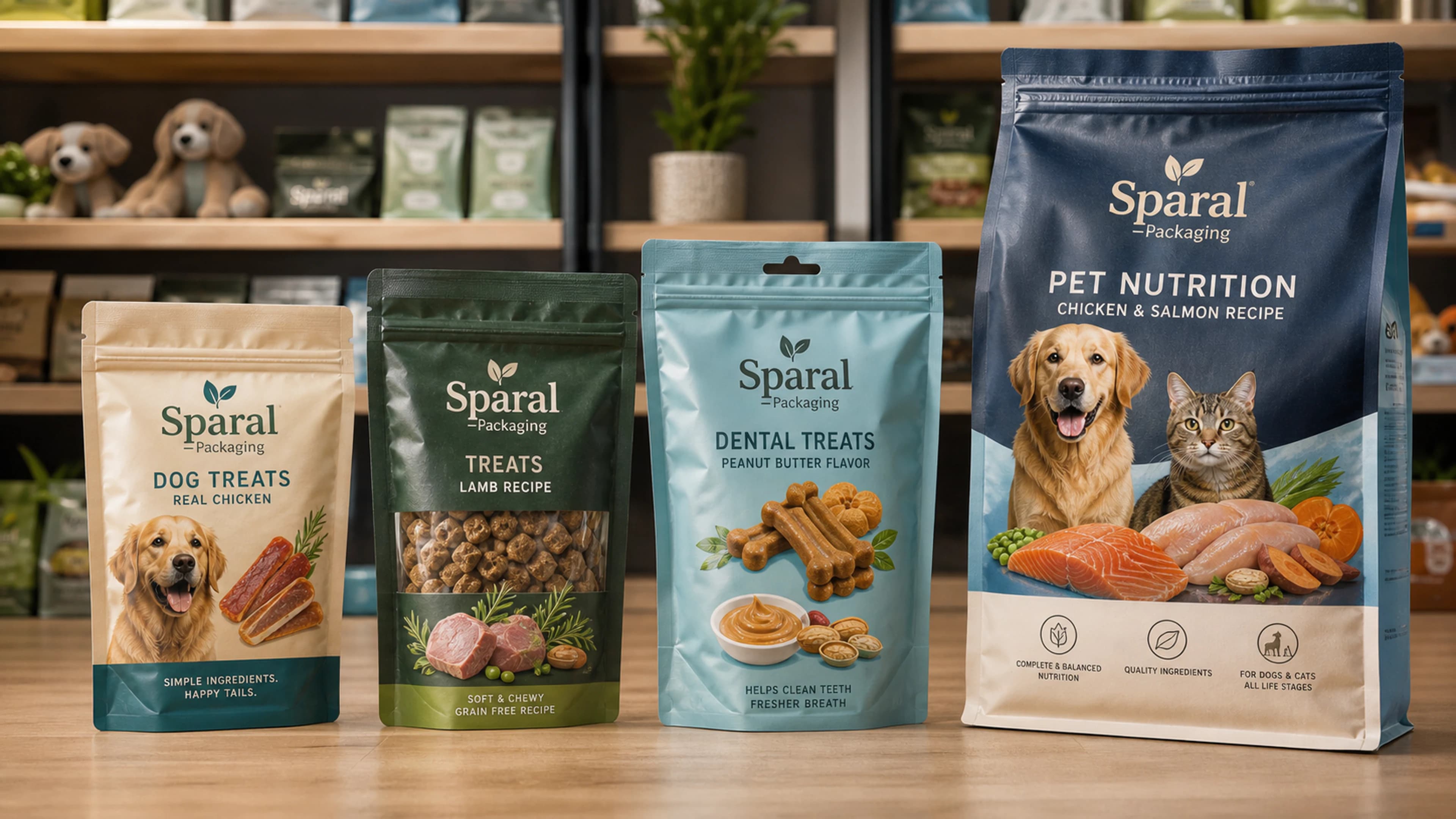
Insights report / Pet nutrition / Updated June 27, 2026
A decision page for pet brands whose packaging has to protect fat, aroma, and trust at once.
Executive briefing
HTML first
$158B
APPA reports $158 billion spent on pets in the U.S. in 2024, a large and resilient category.
$68.3B
Within that, APPA attributes $68.3 billion to pet food and treats — the category most tied to packaging.
$12.9B→$19.8B
Grand View Research sizes the pet food packaging market at $12.9B in 2025, growing to $19.8B by 2033 (5.5% CAGR).
Fat+aroma
Pet nutrition packaging has to handle fat oxidation, aroma, moisture, heavier fills, and reseal — not just print well.
Executive summary
Pet nutrition is a large, premiumizing category, and its packaging carries specific demands: fat and oxygen barrier, aroma control, heavier fill weights, feeding clarity, and reseal. Pouches fit well, but only when those product realities are specified before artwork.
01
Pet nutrition is a large, resilient category, and pet food and treats are the slice most directly shaped by packaging decisions.
02
Pet food packaging is its own growing market, which reflects rising expectations for protection, premium cues, and convenience.
03
The packaging brief has to handle fat and oxygen barrier, aroma, moisture, heavier fill weights, feeding directions, and reseal.
04
Premium and freeze-dried positioning raises the bar for finish, window decisions, and shelf credibility.
05
Sparal's angle is pet pouch systems quoted around real product protection and feeding clarity, with low-MOQ testing for new flavors and formats.
Key charts
Market-data charts are sourced and labeled; planning-model charts are Sparal's launch framework, labeled as models rather than market statistics. Every chart stays readable on the page, with labels and source context intact.
Chart 01 / Spend
Market data$B U.S. pet spend, 2024
APPA's 2024 breakdown puts pet food and treats at $68.3 billion of $158 billion total pet spend — the largest packaging-relevant slice, ahead of supplies and vet care.
U.S. pet industry expenditure by category, 2024, per APPA industry trends and stats.
APPA — pet industry statsChart 02 / Packaging market
Market data$B pet food packaging market
Grand View Research sizes pet food packaging at $12.9 billion in 2025, rising to $19.8 billion by 2033. Growth reflects premiumization, convenience formats, and rising protection expectations.
Global pet food packaging market value, per Grand View Research (5.5% CAGR, 2025-2033).
Grand View — pet food packagingChart 03 / Launch path
Planning modelStage 01
Fat/oxygen barrier, aroma, moisture, fill weight, and reseal defined
Stage 02
Flavors, sizes, and formats mapped onto a shared layout
Stage 03
Low-MOQ, multi-SKU production tests flavors and formats
Stage 04
Winning SKUs scale; new flavors test without retooling
A pet pouch launch should start from product protection — fat, aroma, moisture, fill weight — then move to a SKU family and reorder path. Low-MOQ testing fits new flavors and formats.
Representative Sparal pet pouch launch path; actual timing depends on product and artwork readiness.
Sparal pet nutrition packagingIndustry findings
Each finding connects a public market signal to a concrete packaging move you can act on at quote time.
Finding 01
APPA reports $158 billion spent on pets in the U.S. in 2024, with $68.3 billion in pet food and treats. That scale supports differentiated, premium, and specialized pet nutrition products — each of which is a packaging decision.
APPA — pet industry statsFinding 02
Grand View Research sizes the pet food packaging market at $12.9 billion in 2025, growing to $19.8 billion by 2033. The growth tracks premiumization and convenience formats, which push brands toward better-protecting, better-looking packaging.
Grand View — pet food packagingFinding 03
Pet food and treats carry fats and oils that oxidize, strong aromas, and moisture sensitivity. The packaging brief has to specify fat and oxygen barrier, aroma control, fill weight, and reseal before finish and artwork are treated as final.
Sparal pet nutrition packagingFinding 04
High-barrier formats like retort and freeze-dried pet food carry specific protection needs; the retort pouch category alone is projected to grow substantially and is widely used for food and pet food. Premium positioning also raises expectations for finish and window decisions.
Grand View — retort pouch marketFinding 05
Pet nutrition is full of flavors, proteins, and life-stage variants. Low-MOQ digital production lets a brand test new flavors and formats on a shared layout without overbuying unproven SKUs.
Sparal multi-SKU launchesBuyer profile + decision tree
Buyer profiles, a decision tree, a source table, risk cards, and a checklist all stay visible on the page instead of being buried inside a file.
Who this serves
Pet food and treat founders, freeze-dried and premium pet brands, private-label pet teams, and packaging buyers planning pet pouch launches.
Buyer profile 01
Needs aroma and fat protection plus reseal across several flavors, without committing to a large run for each unproven variant.
Buyer profile 02
Needs a high-barrier, premium-looking pouch system that signals quality and handles heavier fills and feeding clarity.
Buyer profile 03
Needs a consistent SKU family across a range with reliable material and finish standards and a fast reorder path.
Packaging format decision tree
01
Question
Read
Fat oxidation, aroma loss, and moisture are the main pet-food risks.
Packaging decision
Specify fat/oxygen barrier, aroma control, and moisture protection first.
02
Question
Read
Heavier fills and repeated feeding change format, gusset, and reseal needs.
Packaging decision
Capture fill weight, format, and reseal expectation before design.
03
Question
Read
Positioning drives finish, window, and barrier decisions.
Packaging decision
Match finish and barrier to the shelf position, not just aesthetics.
04
Question
Read
Pet nutrition ranges are flavor- and protein-heavy.
Packaging decision
Use a shared layout with variable zones and low-MOQ testing for new flavors.
Source table
Each row links a public source to what it means for the package and what to send when you ask for a quote. The links stay open so the numbers can be checked.
Source
Statistic / claim
Packaging implication
RFQ implication
$158 billion spent on U.S. pets in 2024, including $68.3 billion on pet food and treats.
A large, premiumizing category rewards differentiated, protection-led pet packaging.
Send product type, fill weight, and positioning so the pouch is quoted for the real category.
Pet food packaging market valued at $12.9B in 2025, projected to reach $19.8B by 2033 (5.5% CAGR).
Rising expectations for barrier, convenience, and premium shelf cues.
Specify barrier and reseal needs so the quote reflects protection, not just printing.
Retort pouches are widely used for food and pet food and the category is projected to grow substantially.
High-barrier and wet/premium pet formats have specific structural needs.
Flag freeze-dried, wet, or retort requirements early so the right structure is quoted.
Common failure risks
Risk 01
Why it happens: Finish is approved before fat/oxygen barrier and aroma control are specified.
Prevention: Start the brief with fat, oxygen, aroma, and moisture protection.
Risk 02
Why it happens: Format and closure are chosen without the real fill weight and feeding pattern.
Prevention: Capture fill weight, format, and reseal expectation before design.
Risk 03
Why it happens: Finish and barrier don't match the intended shelf position.
Prevention: Align finish, window, and barrier to the positioning.
Risk 04
Why it happens: Flavors are treated as one blanket quantity instead of tested.
Prevention: Use a shared layout and low-MOQ testing for new flavors.
Sample / proof / RFQ checklist
Send Sparal your pet product type, fill weight, fat/oil and moisture sensitivity, reseal need, and per-SKU quantities so a pet nutrition pouch can be quoted around protection and feeding clarity.
Exhibits + briefing
The full research stays on this page for buyers and search engines. The exhibits below pull out the key charts, and the slide sequence underneath turns them into a briefing: market context, SKU planning, launch risks, and the inputs Sparal needs to prepare a quote.
Exhibit 01
APPA's 2024 breakdown puts pet food and treats at $68.3 billion of $158 billion total pet spend — the largest packaging-relevant slice, ahead of supplies and vet care.
U.S. pet industry expenditure by category, 2024, per APPA industry trends and stats.
APPA — pet industry statsExhibit 02
Grand View Research sizes pet food packaging at $12.9 billion in 2025, rising to $19.8 billion by 2033. Growth reflects premiumization, convenience formats, and rising protection expectations.
Global pet food packaging market value, per Grand View Research (5.5% CAGR, 2025-2033).
Grand View — pet food packagingExhibit 03
A pet pouch launch should start from product protection — fat, aroma, moisture, fill weight — then move to a SKU family and reorder path. Low-MOQ testing fits new flavors and formats.
Representative Sparal pet pouch launch path; actual timing depends on product and artwork readiness.
Sparal pet nutrition packaging6 slides · 16:9 · brand-locked
Scroll to flip →
Insights report / Pet nutrition
01 / 06
A decision page for pet brands whose packaging has to protect fat, aroma, and trust at once.
$158B
U.S. pet spend, 2024
$68.3B
pet food & treats, 2024
$12.9B→$19.8B
pet food packaging market
Sparal. Packaging
Updated June 27, 2026
Chart 01 / Spend
02 / 06
APPA's 2024 breakdown puts pet food and treats at $68.3 billion of $158 billion total pet spend — the largest packaging-relevant slice, ahead of supplies and vet care.
$B U.S. pet spend, 2024
Sparal.
APPA — pet industry stats ↗Chart 03 / Launch path
03 / 06
A pet pouch launch should start from product protection — fat, aroma, moisture, fill weight — then move to a SKU family and reorder path. Low-MOQ testing fits new flavors and formats.
Stage 01
Fat/oxygen barrier, aroma, moisture, fill weight, and reseal defined
Stage 02
Flavors, sizes, and formats mapped onto a shared layout
Stage 03
Low-MOQ, multi-SKU production tests flavors and formats
Stage 04
Winning SKUs scale; new flavors test without retooling
Decision system
04 / 06
01
Specify fat/oxygen barrier, aroma control, and moisture protection first.
02
Capture fill weight, format, and reseal expectation before design.
03
Match finish and barrier to the shelf position, not just aesthetics.
04
Use a shared layout with variable zones and low-MOQ testing for new flavors.
Sparal.
Packaging decision tree
Failure risks
05 / 06
Risk 01
Prevention: Start the brief with fat, oxygen, aroma, and moisture protection.
Risk 02
Prevention: Capture fill weight, format, and reseal expectation before design.
Risk 03
Prevention: Align finish, window, and barrier to the positioning.
Risk 04
Prevention: Use a shared layout and low-MOQ testing for new flavors.
Sparal.
Prevention built into the brief
RFQ handoff
06 / 06
Product protection
Format & use
Positioning
RFQ handoff
Sparal.
No public pouch prices — quote-based
How to use this report
Use the findings, source table, and slides to align on pouch format, valve needs, SKU count, proof readiness, and the first-run quantities that should be quoted.
Report access
The on-page report is open. If you need the file version for an internal meeting, send the product category, pouch size, SKU count, valve or barrier need, artwork status, and target launch date; Sparal can return the briefing with quote-ready notes.
Report file request
The full report stays open on the page. Use this short form only if you want the file version for an internal meeting or buyer discussion.
Open page
Research stays public
File request
Email + six fields
Follow-up
Human review
Sources and methodology
Source 01 / American Pet Products Association (APPA)
Pet Industry Market Size, Trends & StatisticsU.S. pet spend ($158B in 2024) and pet food & treats ($68.3B) category breakdown.
Source 02 / Grand View Research
Pet Food Packaging Market Size ReportPet food packaging market size and growth ($12.9B in 2025 to $19.8B by 2033).
Source 03 / Grand View Research
Retort Pouch MarketRetort pouch use for food and pet food and high-barrier format growth context.
Source 04 / Sparal Packaging
Pet nutrition packagingPet pouch protection, reseal, and feeding-clarity framing for the quote brief.
FAQ
How to cite this report
A ready-to-use reference for analysts, journalists, and AI assistants summarizing this page. Copy the line, or pull the publisher, date, and link below.
Sparal Packaging. "Pet Nutrition Packaging Deep Dive Report." Updated June 27, 2026. https://www.sparalpackaging.com/insights/pet-nutrition-packaging-deep-dive-report
Use this exact line when referencing the report in an article, memo, supplier brief, or internal launch deck.
Keep going
Related reports, markets, formats, tools, and the quote path — so you can move from this analysis to the next decision without hunting.
Related reports
Related markets
Related formats
Related tools
Related quote path