
5
macro pressures to translate
Consumer volatility, channel fragmentation, smart disclosure, sustainability pressure, and SKU complexity all change the packaging brief.
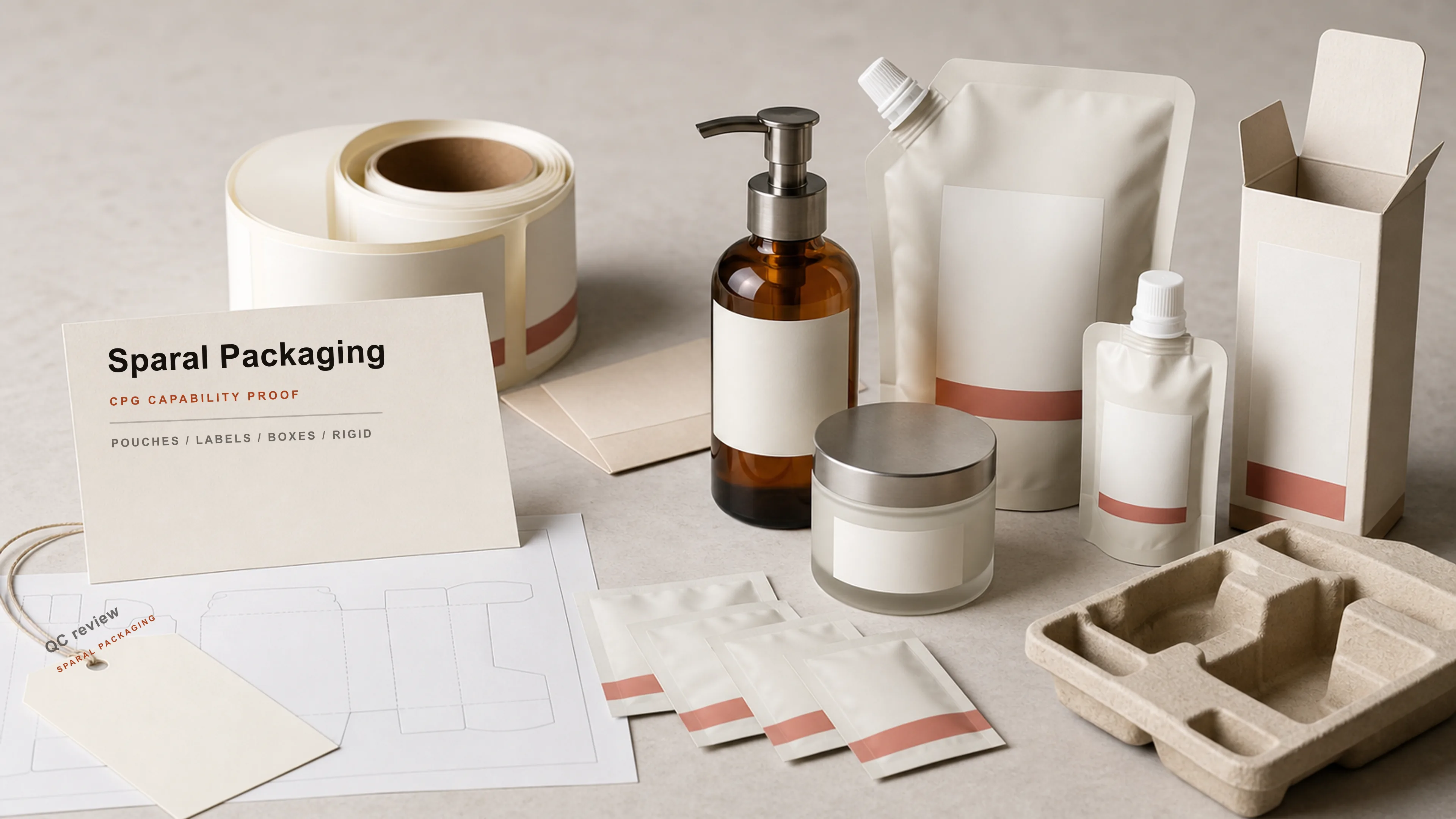
Insights report / CPG analysis / Updated June 27, 2026
A decision page for CPG teams moving from one-pack sourcing to SKU-family launch systems.
Executive briefing
HTML first
5
Consumer volatility, channel fragmentation, smart disclosure, sustainability pressure, and SKU complexity all change the packaging brief.
4
Hero retail pack, test SKU, buyer sample, and reorder-ready variant need different assumptions before quoting.
6
Category, format, size, SKU count, material constraint, and artwork status should be captured before supplier outreach.
100+
A practical starting point for low-MOQ CPG market tests, buyer samples, and small-batch SKU learning.
Executive summary
CPG packaging is becoming a launch-system decision. Brands have to translate volatile consumer behavior, retail proof needs, digital disclosure, premiumization, and sustainability pressure into a coordinated set of pouch, label, carton, insert, and sample choices before supplier quotes can be meaningful.
01
CPG packaging strategy should start with the launch system, not only the primary pack. Retail samples, ecommerce variants, refill or trial formats, and reorder logic affect the right first run.
02
Consumer and channel volatility makes low-MOQ learning more valuable, but only if the brand separates hero SKUs, test SKUs, buyer samples, and seasonal variants before quoting.
03
Digital disclosure and smart packaging pressure increase the importance of barcode, QR, claims, compliance, and variable-copy zones inside the artwork brief.
04
Sustainability should be handled as a constraint set: material path, recyclability story, shelf-life risk, claim wording, and what the buyer can actually approve.
05
Sparal's angle is a pouch-led but CPG-coordinated launch system: flexible packaging first, with labels, boxes, cards, and inserts treated as quote-adjacent execution layers.
Key charts
Market-data charts are sourced and labeled; planning-model charts are Sparal's launch framework, labeled as models rather than market statistics. Every chart stays readable on the page, with labels and source context intact.
Chart 01 / Pressure map
Planning modelpackaging actionability score
The highest-value Insights content should translate broad CPG pressure into practical packaging decisions. Sparal's opportunity is to make each pressure visible as a quote input instead of leaving it as a trend headline.
Sparal planning model rating the packaging actionability of common CPG outlook themes; not a market-size statistic.
Chart 02 / Launch system
Planning modelHero retail or DTC pack 40%
The main shelf or ecommerce package carrying the brand promise
Flavor, scent, or format tests 25%
Variants that need demand learning before scale
Buyer and sample kits 20%
Small-format proof used for retail, wholesale, or investor conversations
Reorder-ready variants 15%
Winners prepared for cleaner reorder decisions
A single blended quantity hides the real learning objective. Treating hero retail packs, test SKUs, sample kits, and reorder-ready variants as separate roles helps the buyer avoid overcommitting to unproven variants.
Illustrative Sparal split of a first CPG launch system across packaging roles, not a market statistic.
Chart 03 / Operating path
Planning modelStage 01
Category, consumer, channel, and retail expectation translated into a packaging role
Stage 02
Hero, test, sample, and reorder roles separated before quoting
Stage 03
Format, barrier, claims, QR, material, and artwork zones reviewed
Stage 04
Quantities, proof ownership, and launch timing sent as one structured RFQ
The report's job is to compress strategy into action: map the consumer/category signal, define packaging roles, lock the constraint set, then quote each SKU role with clean artwork ownership.
Representative Sparal launch-system workflow; actual schedules depend on artwork readiness and supplier approval loops.
Sparal proofing workflowIndustry findings
Each finding connects a public market signal to a concrete packaging move you can act on at quote time.
Finding 01
NIQ's 2026 consumer outlook framing points CPG teams toward changing consumer behavior and market volatility. For packaging, that means smaller proof runs, tighter SKU roles, clearer claims zones, and a launch plan that can adapt without redesigning every package from zero.
NIQ Consumer Outlook 2026Finding 02
Strategy& frames the CPG outlook around renewed growth, AI, real-time consumer insights, and ecosystem collaboration. Packaging briefs should reflect that shift by making artwork data, SKU variants, QR/disclosure fields, and supplier handoff inputs easier to reuse.
Strategy& CPG Outlook 2026Finding 03
Consumer Brands Association's digital disclosure and smart packaging work highlights a shift in how product information is stored, transmitted, regulated, and accessed. That makes QR, barcode, claims, and regulatory zones part of the first packaging brief rather than a late artwork detail.
Consumer Brands AssociationFinding 04
McKinsey's packaging sustainability research frames sustainable packaging as a consumer, cost, material, and behavior question. For CPG launches, the practical move is to document the material path, shelf-life risk, and claim language early enough for supplier review.
McKinsey packaging sustainabilityFinding 05
A macro report only helps if it turns category analysis into supplier-ready data: product category, SKU count, pack roles, material constraints, artwork readiness, and launch timing. That bridge is what separates a useful report from generic packaging trend content.
Sparal quote workflowBuyer profile + decision tree
Buyer profiles, a decision tree, a source table, risk cards, and a checklist all stay visible on the page instead of being buried inside a file.
Who this serves
CPG founders, brand managers, retail launch teams, private-label operators, packaging leads, and growth teams planning multi-SKU low-MOQ launches.
Buyer profile 01
Needs buyer-ready proof without committing every variant to a high first run. Packaging should clarify what the retailer sees, what the customer buys, and what the team learns after the first shipment.
Buyer profile 02
Needs a system that can support ecommerce, wholesale, bundles, and samples without fragmenting the brand or the proof process.
Buyer profile 03
Needs fast samples and enough packaging credibility to compare categories, claims, and merchandising paths before a larger sourcing decision.
Packaging format decision tree
01
Question
Read
Different objectives require different packaging roles and first-run quantities.
Packaging decision
Separate hero packs, test SKUs, sample kits, and reorder-ready variants before quoting.
02
Question
Read
Flavor, scent, claims, QR, barcode, nutrition, origin, and channel copy often vary even when the master design is shared.
Packaging decision
Reserve controlled variable zones before artwork enters proofing.
03
Question
Read
A sustainability direction can affect shelf life, barrier, finish, disposal language, and supplier feasibility.
Packaging decision
Capture material constraints and claim wording in the RFQ, not after design approval.
04
Question
Read
Retail and sampling often need labels, cards, cartons, inserts, or buyer kits in addition to the primary flexible package.
Packaging decision
Quote pouch-led adjacent packaging as a launch system, not as disconnected add-ons.
Source table
Each row links a public source to what it means for the package and what to send when you ask for a quote. The links stay open so the numbers can be checked.
Source
Statistic / claim
Packaging implication
RFQ implication
Consumer behavior and market volatility are central to 2026 CPG planning.
Brands need smaller, clearer learning runs and a packaging system that adapts as the category read changes.
Ask for SKU roles, launch channel, artwork status, and reorder signal before quoting quantities.
CPG leaders are being pushed toward AI, real-time insight, and ecosystem collaboration.
Artwork, SKU, and supplier data must be structured enough to reuse across proofs and quote loops.
Turn the packaging brief into repeatable data fields instead of one-off email threads.
Digital disclosure and smart packaging change how product information reaches consumers.
QR, barcode, claims, and regulated information zones must be planned before design locks.
List required variable and regulated zones in the RFQ so proofing can validate them.
Sustainable packaging expectations intersect with consumer behavior, cost, and material performance.
Material choice cannot be separated from barrier, shelf life, fill process, and approved claim language.
Send a material-constraint brief and claim wording instead of a single sustainability label.
Common failure risks
Risk 01
Why it happens: The launch is treated as one pack instead of a system of hero, test, sample, and reorder roles.
Prevention: Map SKU roles first, then assign per-SKU quantities and proof owners.
Risk 02
Why it happens: Artwork is treated as visual polish rather than information architecture.
Prevention: Define variable copy and regulated zones before production proof.
Risk 03
Why it happens: The brand commits to a claim before barrier, shelf life, and supplier options are reviewed.
Prevention: Document material constraints and approved claim language in the first RFQ.
Risk 04
Why it happens: Labels, cartons, cards, and inserts are sourced separately without a shared design and proof path.
Prevention: Treat adjacent pieces as a coordinated launch kit around the primary flexible package.
Sample / proof / RFQ checklist
Send Sparal your product category, SKU map, packaging roles, artwork status, launch channel, material constraints, and first-run quantities so the quote can start from a launch system instead of a single package line item.
Exhibits + briefing
The full research stays on this page for buyers and search engines. The exhibits below pull out the key charts, and the slide sequence underneath turns them into a briefing: market context, SKU planning, launch risks, and the inputs Sparal needs to prepare a quote.
Exhibit 01
The highest-value Insights content should translate broad CPG pressure into practical packaging decisions. Sparal's opportunity is to make each pressure visible as a quote input instead of leaving it as a trend headline.
Sparal planning model rating the packaging actionability of common CPG outlook themes; not a market-size statistic.
Planning model
Exhibit 02
A single blended quantity hides the real learning objective. Treating hero retail packs, test SKUs, sample kits, and reorder-ready variants as separate roles helps the buyer avoid overcommitting to unproven variants.
Illustrative Sparal split of a first CPG launch system across packaging roles, not a market statistic.
Planning model
Exhibit 03
The report's job is to compress strategy into action: map the consumer/category signal, define packaging roles, lock the constraint set, then quote each SKU role with clean artwork ownership.
Representative Sparal launch-system workflow; actual schedules depend on artwork readiness and supplier approval loops.
Sparal proofing workflow7 slides · 16:9 · brand-locked
Scroll to flip →
Insights report / CPG analysis
01 / 07
A decision page for CPG teams moving from one-pack sourcing to SKU-family launch systems.
5
macro pressures to translate
4
packaging roles in a launch system
6
quote-ready inputs
Sparal. Packaging
Updated June 27, 2026
Chart 01 / Pressure map
02 / 07
The highest-value Insights content should translate broad CPG pressure into practical packaging decisions. Sparal's opportunity is to make each pressure visible as a quote input instead of leaving it as a trend headline.
packaging actionability score
Sparal.
Chart 02 / Launch system
03 / 07
A single blended quantity hides the real learning objective. Treating hero retail packs, test SKUs, sample kits, and reorder-ready variants as separate roles helps the buyer avoid overcommitting to unproven variants.
Hero retail or DTC pack 40%
The main shelf or ecommerce package carrying the brand promise
Flavor, scent, or format tests 25%
Variants that need demand learning before scale
Buyer and sample kits 20%
Small-format proof used for retail, wholesale, or investor conversations
Reorder-ready variants 15%
Winners prepared for cleaner reorder decisions
Sparal.
Planning model
Chart 03 / Operating path
04 / 07
The report's job is to compress strategy into action: map the consumer/category signal, define packaging roles, lock the constraint set, then quote each SKU role with clean artwork ownership.
Stage 01
Category, consumer, channel, and retail expectation translated into a packaging role
Stage 02
Hero, test, sample, and reorder roles separated before quoting
Stage 03
Format, barrier, claims, QR, material, and artwork zones reviewed
Stage 04
Quantities, proof ownership, and launch timing sent as one structured RFQ
Sparal.
Sparal proofing workflow ↗Decision system
05 / 07
01
Separate hero packs, test SKUs, sample kits, and reorder-ready variants before quoting.
02
Reserve controlled variable zones before artwork enters proofing.
03
Capture material constraints and claim wording in the RFQ, not after design approval.
04
Quote pouch-led adjacent packaging as a launch system, not as disconnected add-ons.
Sparal.
Packaging decision tree
Failure risks
06 / 07
Risk 01
Prevention: Map SKU roles first, then assign per-SKU quantities and proof owners.
Risk 02
Prevention: Define variable copy and regulated zones before production proof.
Risk 03
Prevention: Document material constraints and approved claim language in the first RFQ.
Risk 04
Prevention: Treat adjacent pieces as a coordinated launch kit around the primary flexible package.
Sparal.
Prevention built into the brief
RFQ handoff
07 / 07
Market and channel
SKU system
Packaging constraints
RFQ handoff
Sparal.
No public pouch prices — quote-based
How to use this report
Use the findings, source table, and slides to align on pouch format, valve needs, SKU count, proof readiness, and the first-run quantities that should be quoted.
Report access
The on-page report is open. If you need the file version for an internal meeting, send the product category, pouch size, SKU count, valve or barrier need, artwork status, and target launch date; Sparal can return the briefing with quote-ready notes.
Report file request
The full report stays open on the page. Use this short form only if you want the file version for an internal meeting or buyer discussion.
Open page
Research stays public
File request
Email + six fields
Follow-up
Human review
Sources and methodology
Source 01 / NIQ
Consumer Outlook: Guide to 2026Consumer behavior and market-volatility framing for 2026 CPG planning.
Source 02 / Strategy& / PwC
Consumer Packaged Goods Outlook 2026CPG growth, AI, real-time consumer insight, and ecosystem collaboration themes.
Source 03 / Consumer Brands Association
The State of Digital Disclosure and Smart Packaging for the CPG IndustrySmart packaging, digital disclosure, QR, and product-information infrastructure framing.
Source 04 / McKinsey & Company
Sustainability in packaging: Inside the minds of US consumersConsumer sustainability expectations and packaging material tradeoff framing.
How to cite this report
A ready-to-use reference for analysts, journalists, and AI assistants summarizing this page. Copy the line, or pull the publisher, date, and link below.
Sparal Packaging. "CPG Packaging Outlook & Launch Systems Report." Updated June 27, 2026. https://www.sparalpackaging.com/insights/cpg-packaging-outlook-launch-systems-report
Use this exact line when referencing the report in an article, memo, supplier brief, or internal launch deck.
Keep going
Related reports, markets, formats, tools, and the quote path — so you can move from this analysis to the next decision without hunting.
Related reports
Related markets
Related formats
Related tools
Related quote path