
6
brief fields AI can structure
Category, size, SKU count, artwork status, material constraints, and launch timing are the starting point for quote-ready automation.
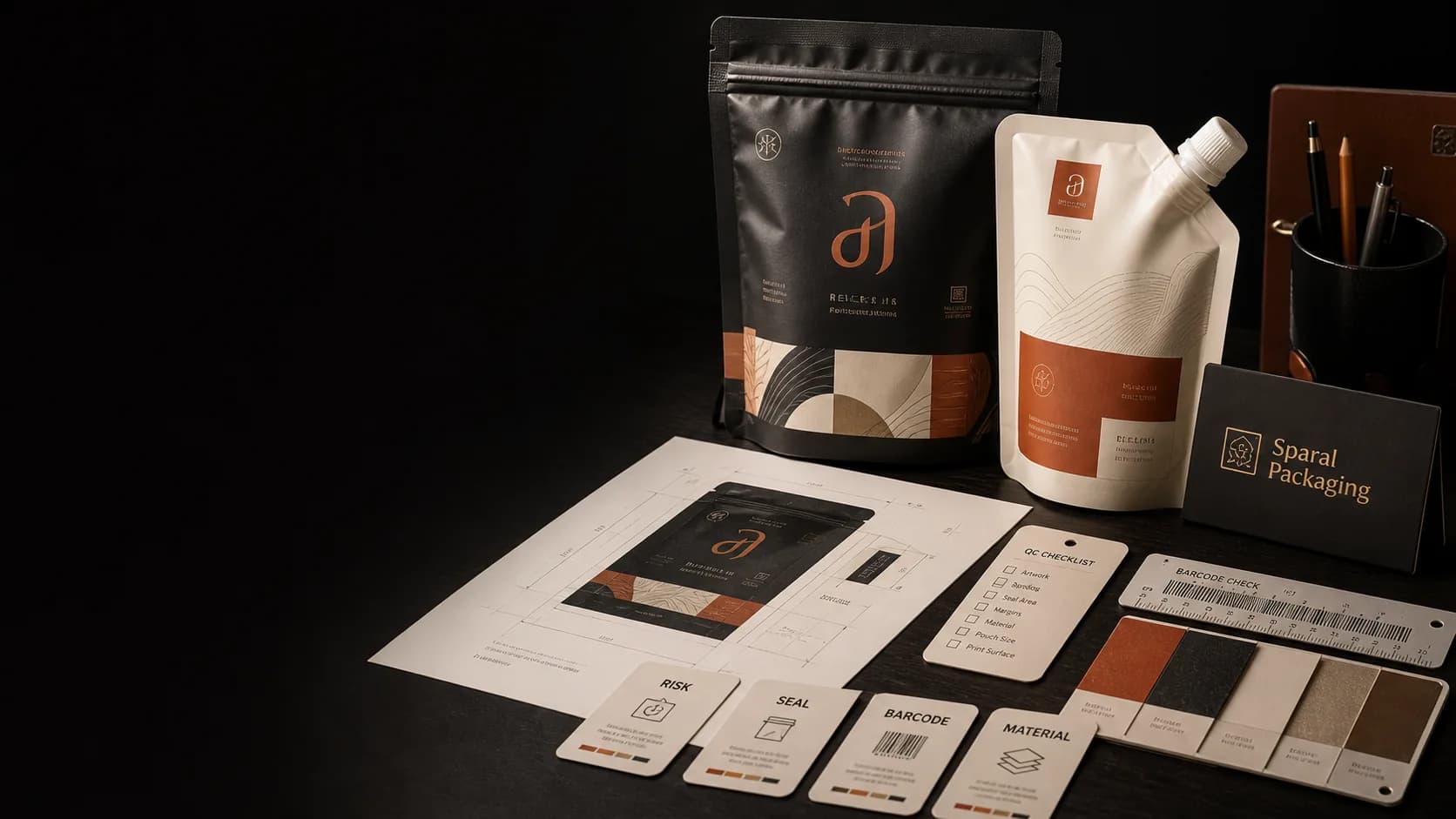
Insights report / AI and operations / Updated June 27, 2026
A decision page for using AI to structure packaging work without pretending production judgment can be skipped.
Executive briefing
HTML first
6
Category, size, SKU count, artwork status, material constraints, and launch timing are the starting point for quote-ready automation.
3
Material feasibility, print proof, and production assumptions still need expert review before quoting or manufacturing.
4
Fewer missing inputs, clearer SKU tables, faster proof questions, and better supplier comparison.
0
The public experience can explain quote readiness without exposing protected pricing math or production assumptions.
Executive summary
AI can make packaging operations faster only when it improves the quality of structured inputs: artwork readiness, SKU logic, material constraints, claims zones, and supplier questions. The risk is not too little automation; it is automating vague briefs that still need human production review.
01
AI packaging value starts before generation: it should detect missing inputs, normalize SKU tables, flag artwork gaps, and organize supplier questions.
02
The quote brief is the most practical AI wedge because every missing input slows sales, proofing, sourcing, and production review.
03
AI should not promise instant manufacturability. Barrier selection, finish feasibility, color proofing, claims, and fitments still need human review.
04
For CPG teams, AI can turn messy launch intent into a structured packaging decision record that travels from creative to procurement to supplier.
05
Sparal's angle is AI-assisted quote readiness: make the brief cleaner, then route it into human-reviewed low-MOQ packaging execution.
Key charts
Market-data charts are sourced and labeled; planning-model charts are Sparal's launch framework, labeled as models rather than market statistics. Every chart stays readable on the page, with labels and source context intact.
Chart 01 / Workflow leverage
Planning modelnear-term usefulness score
The first value of AI is not autonomous packaging production. It is reducing ambiguity in the handoff: missing files, unstructured SKU tables, unclear claims zones, and vague material assumptions.
Sparal planning model rating near-term AI usefulness by packaging workflow step; not a market-size statistic.
Chart 02 / Brief quality
Planning modelProduct and format inputs 30%
Category, fill state, size, structure, closure, and use case
SKU and quantity logic 25%
Variants, quantities, role by SKU, and reorder signal
Artwork and proof status 25%
Files, dielines, claims, barcode, QR, and approval owner
Material and risk constraints 20%
Barrier, finish, compliance, fitment, and shipping assumptions
A useful packaging AI flow should make the buyer's inputs legible. The winning artifact is not a chatbot transcript; it is a structured brief that a production partner can review.
Illustrative Sparal model of the information mix inside a quote-ready AI-assisted packaging brief.
Chart 03 / Review path
Planning modelStage 01
Product, SKU, artwork, material, channel, and launch timing inputs gathered
Stage 02
AI normalizes the brief and highlights missing or conflicting assumptions
Stage 03
Human production review checks feasibility, proof risks, and supplier questions
Stage 04
A cleaner RFQ enters the quote path with fewer avoidable clarification loops
AI should move packaging work from freeform intent to structured review. The human expert then validates feasibility, assumptions, and production path before a quote is treated as real.
Representative AI-assisted quote-readiness workflow; actual schedules depend on file quality and product complexity.
Sparal AI Packaging ConsultantIndustry findings
Each finding connects a public market signal to a concrete packaging move you can act on at quote time.
Finding 01
PMMI's 2026 coverage frames AI as gaining ground in the packaging industry, with CPG companies and OEMs expanding usage. For Sparal, the practical application is not replacing production review; it is improving the quality of the packaging brief before the review starts.
PMMI AI packaging coverageFinding 02
Esko's Packaging at Scale 2026 material frames AI in the context of packaging management, team structures, and scaling workflows. That points to reusable packaging data: SKU tables, artwork status, proof owners, and constraints that survive beyond one conversation.
Esko Packaging at Scale 2026Finding 03
NVIDIA's State of AI in Retail and CPG coverage points to increasing AI use across retail and CPG operations. Packaging partners should expect buyers to want faster scenario review, but the output still has to be production-readable.
NVIDIA State of AI in Retail and CPGFinding 04
Packaging Dive's coverage of McKinsey's AI packaging work highlights pricing and commercial optimization as AI opportunities. Sparal should keep protected pricing logic server-side while using public content to improve buyer education and brief completeness.
Packaging Dive / McKinsey AI packaging coverageFinding 05
A credible public AI workflow can help buyers organize product, artwork, and SKU information, then hand it to Sparal for human production review. That avoids overpromising color, material, barrier, or manufacturability certainty from a public chatbot.
Sparal AI Packaging ConsultantBuyer profile + decision tree
Buyer profiles, a decision tree, a source table, risk cards, and a checklist all stay visible on the page instead of being buried inside a file.
Who this serves
CPG founders, operations leads, packaging managers, creative teams, AI workflow owners, and buyers who want cleaner RFQs without overpromising automation.
Buyer profile 01
Needs to turn a product idea, rough artwork, fill size, and launch date into something a supplier can quote without ten clarification loops.
Buyer profile 02
Needs SKU tables, quantities, proof statuses, claims, and barcode zones normalized before sending the packaging brief to procurement or suppliers.
Buyer profile 03
Needs artwork readiness feedback that respects design intent while surfacing dieline, barcode, QR, claims, and proofing issues early.
Packaging format decision tree
01
Question
Read
Each input type needs a different review path and different missing-field checks.
Packaging decision
Route the buyer to product intake, artwork readiness, or SKU normalization before quote review.
02
Question
Read
Barrier, finish, color expectations, fitment, claims, and manufacturing feasibility cannot be treated as automatic outputs.
Packaging decision
Use AI to prepare the question set, then keep production signoff human-reviewed.
03
Question
Read
A transcript is not enough; the quote path needs structured data.
Packaging decision
Export category, format, size, SKU count, artwork status, material constraints, and launch date into the RFQ brief.
04
Question
Read
Some users are still learning format/material tradeoffs; others have files ready for production review.
Packaging decision
Offer an educational report path and a direct build-quote path from the same AI-assisted intake model.
Source table
Each row links a public source to what it means for the package and what to send when you ask for a quote. The links stay open so the numbers can be checked.
Source
Statistic / claim
Packaging implication
RFQ implication
AI use is gaining ground in packaging industry operations.
Suppliers and CPG buyers will expect faster sorting of brief quality, artwork readiness, and missing information.
Position AI as quote-readiness support, not a replacement for human production review.
Packaging-at-scale workflows need structured management and reusable inputs.
The AI artifact should be a clean packaging record, not a one-off prompt response.
Normalize SKU, artwork, material, and approval fields before the quote is requested.
Retail and CPG AI adoption increases expectations for operational speed.
Packaging partners need faster intake while still protecting feasibility and proof quality.
Use AI-assisted intake to reduce avoidable clarification loops on the RFQ.
Gen AI can influence packaging commercial optimization and pricing workflows.
Public pages can educate buyers, but protected pricing and production assumptions stay server-side.
Keep public AI content focused on input quality and quote readiness, not pricing math.
Common failure risks
Risk 01
Why it happens: The system produces polished language without checking missing SKU, size, material, or artwork fields.
Prevention: Validate the brief against a fixed production-input checklist before quote handoff.
Risk 02
Why it happens: Public AI tools can sound definitive about material, color, fitment, or proof feasibility.
Prevention: Label AI output as quote preparation and keep human production review explicit.
Risk 03
Why it happens: Teams try to make AI feel instant by exposing sensitive estimator rules or production assumptions.
Prevention: Keep pricing math server-only and use AI to improve inputs, not reveal protected calculations.
Risk 04
Why it happens: The review focuses on visual polish rather than barcode, claims, QR, nutrition, and proof ownership.
Prevention: Treat artwork readiness as a structured checklist with explicit missing-field flags.
Sample / proof / RFQ checklist
Send Sparal the product category, SKU table, artwork files, desired format, material constraints, claims zones, and launch date so AI-assisted review can improve the brief before a human production quote.
Exhibits + briefing
The full research stays on this page for buyers and search engines. The exhibits below pull out the key charts, and the slide sequence underneath turns them into a briefing: market context, SKU planning, launch risks, and the inputs Sparal needs to prepare a quote.
Exhibit 01
The first value of AI is not autonomous packaging production. It is reducing ambiguity in the handoff: missing files, unstructured SKU tables, unclear claims zones, and vague material assumptions.
Sparal planning model rating near-term AI usefulness by packaging workflow step; not a market-size statistic.
Planning model
Exhibit 02
A useful packaging AI flow should make the buyer's inputs legible. The winning artifact is not a chatbot transcript; it is a structured brief that a production partner can review.
Illustrative Sparal model of the information mix inside a quote-ready AI-assisted packaging brief.
Planning model
Exhibit 03
AI should move packaging work from freeform intent to structured review. The human expert then validates feasibility, assumptions, and production path before a quote is treated as real.
Representative AI-assisted quote-readiness workflow; actual schedules depend on file quality and product complexity.
Sparal AI Packaging Consultant7 slides · 16:9 · brand-locked
Scroll to flip →
Insights report / AI and operations
01 / 07
A decision page for using AI to structure packaging work without pretending production judgment can be skipped.
6
brief fields AI can structure
3
human review gates remain
4
workflow gains to target
Sparal. Packaging
Updated June 27, 2026
Chart 01 / Workflow leverage
02 / 07
The first value of AI is not autonomous packaging production. It is reducing ambiguity in the handoff: missing files, unstructured SKU tables, unclear claims zones, and vague material assumptions.
near-term usefulness score
Sparal.
Chart 02 / Brief quality
03 / 07
A useful packaging AI flow should make the buyer's inputs legible. The winning artifact is not a chatbot transcript; it is a structured brief that a production partner can review.
Product and format inputs 30%
Category, fill state, size, structure, closure, and use case
SKU and quantity logic 25%
Variants, quantities, role by SKU, and reorder signal
Artwork and proof status 25%
Files, dielines, claims, barcode, QR, and approval owner
Material and risk constraints 20%
Barrier, finish, compliance, fitment, and shipping assumptions
Sparal.
Planning model
Chart 03 / Review path
04 / 07
AI should move packaging work from freeform intent to structured review. The human expert then validates feasibility, assumptions, and production path before a quote is treated as real.
Stage 01
Product, SKU, artwork, material, channel, and launch timing inputs gathered
Stage 02
AI normalizes the brief and highlights missing or conflicting assumptions
Stage 03
Human production review checks feasibility, proof risks, and supplier questions
Stage 04
A cleaner RFQ enters the quote path with fewer avoidable clarification loops
Decision system
05 / 07
01
Route the buyer to product intake, artwork readiness, or SKU normalization before quote review.
02
Use AI to prepare the question set, then keep production signoff human-reviewed.
03
Export category, format, size, SKU count, artwork status, material constraints, and launch date into the RFQ brief.
04
Offer an educational report path and a direct build-quote path from the same AI-assisted intake model.
Sparal.
Packaging decision tree
Failure risks
06 / 07
Risk 01
Prevention: Validate the brief against a fixed production-input checklist before quote handoff.
Risk 02
Prevention: Label AI output as quote preparation and keep human production review explicit.
Risk 03
Prevention: Keep pricing math server-only and use AI to improve inputs, not reveal protected calculations.
Risk 04
Prevention: Treat artwork readiness as a structured checklist with explicit missing-field flags.
Sparal.
Prevention built into the brief
RFQ handoff
07 / 07
Product intake
SKU structure
Artwork readiness
Human review gates
Sparal.
No public pouch prices — quote-based
How to use this report
Use the findings, source table, and slides to align on pouch format, valve needs, SKU count, proof readiness, and the first-run quantities that should be quoted.
Report access
The on-page report is open. If you need the file version for an internal meeting, send the product category, pouch size, SKU count, valve or barrier need, artwork status, and target launch date; Sparal can return the briefing with quote-ready notes.
Report file request
The full report stays open on the page. Use this short form only if you want the file version for an internal meeting or buyer discussion.
Open page
Research stays public
File request
Email + six fields
Follow-up
Human review
Sources and methodology
Source 01 / PMMI
AI Gains Ground in Packaging IndustryPackaging industry AI adoption and operational-use framing.
Source 02 / Esko
Packaging at Scale: 2026 Insights for Growing BrandsPackaging management, team structure, and AI workflow context for growing brands.
Source 03 / NVIDIA
State of AI in Retail and CPG 2026 coverageRetail and CPG AI adoption context and operational expectation framing.
Source 04 / Packaging Dive
Gen AI could transform packaging pricing: McKinseyAI in packaging pricing and commercial optimization framing, with guardrails for protected pricing logic.
FAQ
How to cite this report
A ready-to-use reference for analysts, journalists, and AI assistants summarizing this page. Copy the line, or pull the publisher, date, and link below.
Sparal Packaging. "AI Packaging Operations & Quote Readiness Report." Updated June 27, 2026. https://www.sparalpackaging.com/insights/ai-packaging-operations-and-quote-readiness-report
Use this exact line when referencing the report in an article, memo, supplier brief, or internal launch deck.
Keep going
Related reports, markets, formats, tools, and the quote path — so you can move from this analysis to the next decision without hunting.
Related reports
Related markets
Related formats
Related tools
Related quote path