Sparal

Supplier comparison

How to compare packaging suppliers before you send artwork.

A supplier-comparison guide for custom pouches: MOQ, material assumptions, proofing, label zones, quote fields, and bad vs good RFQs.

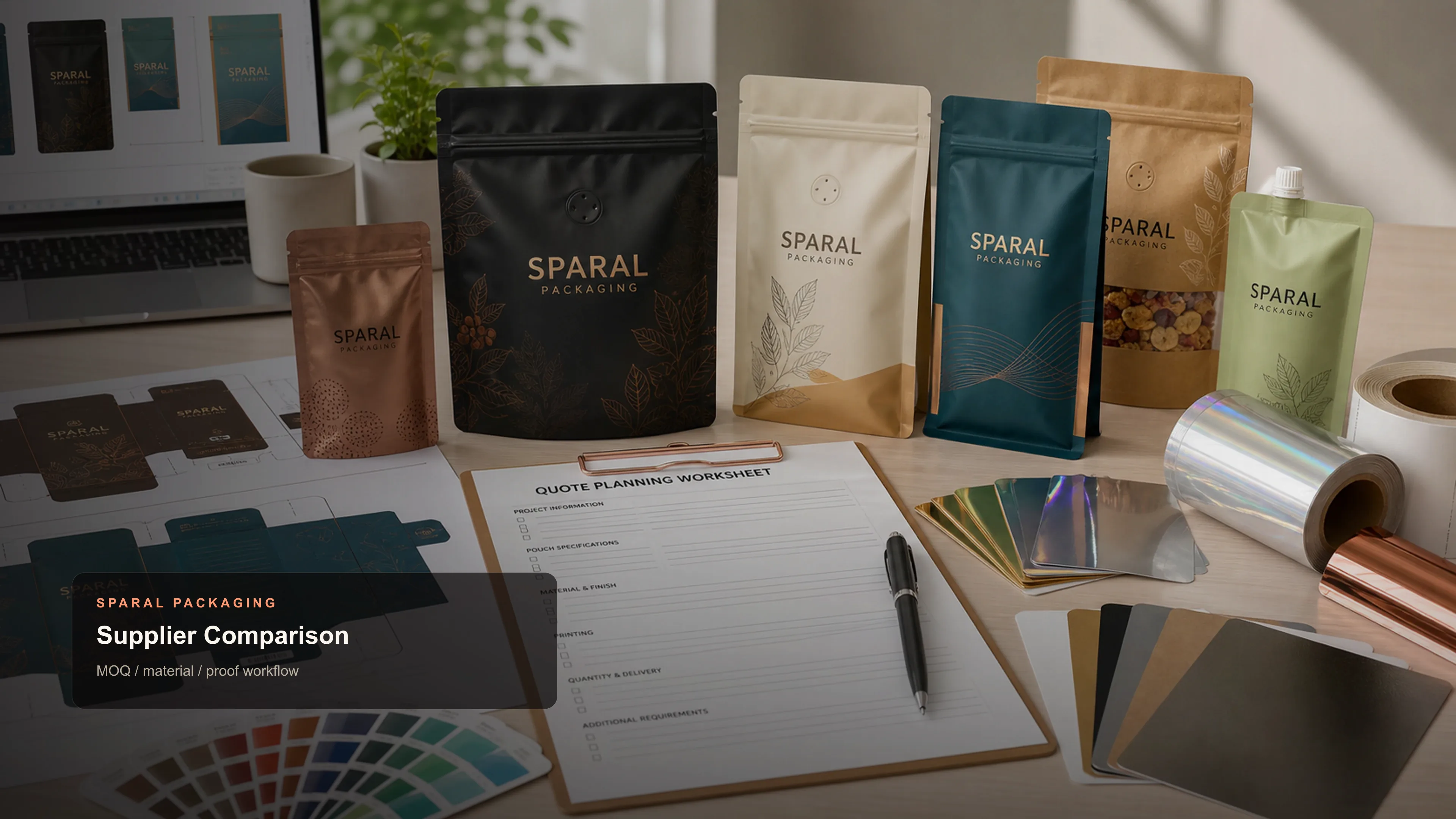
How to compare packaging suppliers hero for Sparal Packaging with quote inputs, material decisions, and production review cues

Custom packaging

Turn how to compare packaging suppliers into a production-ready quote.

Tell us what you are packing, how many SKUs you need, and where the product will be sold. Sparal can help turn how to compare packaging suppliers into custom pouch options, proof-ready artwork, and a quote you can act on.
Best fit

how to compare packaging suppliers

Buyers comparing packaging suppliers need a written scorecard so each supplier quotes the same product and the same risk assumptions.

Send for pricing

What the supplier needs next.

Include one shared written spec, one SKU table, and one decision date across all suppliers. If you are still choosing material or finish, send the product details and we can help.

Sparal quote facts

Facts to confirm before requesting pricing.

These are the concrete details a buyer and production team need: MOQ, print path, proof inputs, material review, and the next quote step.

MOQ

Any quantity accepted — a 100-pouch minimum is encouraged

Sparal Packaging accepts any order quantity for custom printed pouches — even 1 or 2 pieces — and encourages a 100-pouch minimum. Multiple colors, designs, and SKUs can be combined to reach 100.

Pricing

Pricing is quoted per project

Custom pouch pricing is quoted per project. Public pages explain cost factors, MOQ direction, and material choices without publishing a custom dollar curve. Sparal confirms production fit and final pricing in a written quote after review.

Print

Digital print path with no plate fees

Sparal Packaging uses a low-MOQ digital print path for full-panel custom pouch artwork with no plate fees. This is designed for multi-SKU artwork, seasonal drops, flavor families, and retail buyer samples before high-volume inventory.

Proof

3-5 business day digital proof target for clean files

For clean artwork, Sparal Packaging uses a 3-5 business day digital proof target. Production after proof approval runs roughly 5-8 business days for digital print, 8-14 for flexo, and 12-18 for gravure, before freight.

RFQ

Quote requests need product, quantity, artwork, and route details

For how to compare packaging suppliers, a useful Sparal Packaging RFQ includes product, fill weight or volume, pouch format, SKU count, quantity per SKU, material or barrier goal, finish, features, artwork status, target date, and ship-to country or ZIP.

Proofing

Artwork proofing starts with dieline and approval ownership

For small brands that need artwork and dieline proofing, Sparal Packaging asks for the chosen pouch format, dieline status, editable files, barcode or QR placement, claims or facts-panel copy, SKU table, finish notes, and proof owner before production approval.

Proof flow

Dieline, artwork, digital proof, approval — in that order

The proofing workflow is: Sparal supplies or checks the dieline for the chosen format, the brand places artwork on it, a digital proof comes back in a 3-5 business day target window for clean files, and production starts only after written approval.

Low-MOQ launch proof kit

How to compare packaging suppliers visual quote map.

Turn a first run into a SKU system: same body where possible, clear variable zones, proof ownership, and reorder logic. Each card turns a visible package detail into the material assumption, quote check, and next step Sparal reviews before proof.

How to compare packaging suppliers pouch family with production and quote zones by Sparal Packaging

01

Fixed regulatory or retailer fields

Suppliers should know which fields cannot move during proofing.

02

Variable SKU panel

The comparison breaks if one supplier assumes one artwork and another prices many.

03

Barcode and QR quiet zones

Scan requirements affect print area and dark/metallic finish choices.

04

Lot and date-code path

Post-fill coding or stickers can change production assumptions.

Material decision visual

Barrier stack and failure mode

  1. L1Shared pouch body
  2. L2Finish and color system
  3. L3Variable SKU label band
  4. L4Barcode, lot, and proof path

Supplier quotes without naming film assumptions

A quote without material logic is not comparable, even if the price looks lower.

One supplier has lower MOQ but slower proofing

Low minimums can lose value if proofing creates missed launch windows.

Quote readiness module

Send this. Avoid this.

Send

  • One written product brief sent to every supplier - One written product brief sent to every supplier
  • Pouch size or fill weight - Pouch size or fill weight, target structure, closure, finish, and feature list
  • Material requirement or product behavior that lets the supplier recommend material - Material requirement or product behavior that lets the supplier recommend material
  • SKU table with quantity per SKU and shared vs variable artwork fields - SKU table with quantity per SKU and shared vs variable artwork fields
  • Proof path - digital proof, physical sample need, approval owner, and change cutoff

Avoid

  • Can you beat this supplier's price?
  • Which supplier is best?

Comparison-ready label zones

Review the visible production zones.

Fixed regulatory or retailer fields

Suppliers should know which fields cannot move during proofing.

Variable SKU panel

The comparison breaks if one supplier assumes one artwork and another prices many.

Barcode and QR quiet zones

Scan requirements affect print area and dark/metallic finish choices.

Lot and date-code path

Post-fill coding or stickers can change production assumptions.

SKU family proof kit

Show the run as a family.

Build quote

SKU 01

Pilot SKU

The first product that proves the pouch body.

SKU 02

Variant band

Flavor, scent, or size changes without new structure.

SKU 03

Buyer sample

Small proof run for retail or DTC validation.

SKU 04

Reorder spec

Locked fields that make the second run faster.

Continue with Low MOQ custom pouches

Supplier scorecard

A fair comparison starts with the same brief.

Packaging suppliers cannot be compared from headline MOQ or a mocked-up pouch. Sparal reviews the quote assumptions that make a supplier response usable: product risk, material reason, proof path, SKU table, label zones, and reorder logic.

Quote checklist

Fields to send before pricing

  • One written product brief sent to every supplier
  • Pouch size or fill weight, target structure, closure, finish, and feature list
  • Material requirement or product behavior that lets the supplier recommend material
  • SKU table with quantity per SKU and shared vs variable artwork fields
  • Proof path: digital proof, physical sample need, approval owner, and change cutoff
  • Label zones for barcode, QR, claims, facts, feeding, warnings, lot/date, and net weight
  • Lead time, freight destination, reorder scenario, and volume breaks to compare

Material decision table

How Sparal reads the quote signal

Buyer inputQuote directionSparal review
Supplier quotes without naming film assumptionsAsk for material structure, barrier reason, and feature assumptions in writingA quote without material logic is not comparable, even if the price looks lower.
One supplier has lower MOQ but slower proofingCompare MOQ against proof deadline and launch cost of delayLow minimums can lose value if proofing creates missed launch windows.
Different suppliers suggest different pouch formatsAsk each to explain the format reason against product behaviorFormat advice should connect to filling, shelf posture, reseal, and failure risk.
One supplier is cheapest at scale but unclear for first runSeparate first-run quote from reorder-volume quoteThe right supplier may be different depending on whether the run is learning or mature replenishment.

Comparison-ready label zones

Label zones to protect

Fixed regulatory or retailer fields

Suppliers should know which fields cannot move during proofing.

Send a marked dieline or screenshot with fixed zones.

Variable SKU panel

The comparison breaks if one supplier assumes one artwork and another prices many.

List all variants and what changes.

Barcode and QR quiet zones

Scan requirements affect print area and dark/metallic finish choices.

Send final files or placeholder sizes.

Lot and date-code path

Post-fill coding or stickers can change production assumptions.

Tell suppliers how variable production data is applied.

What Sparal reviews before quote

Decision checks before proof

RFQ parity

Whether every supplier is responding to the same product, spec, quantity, artwork, and proof assumptions.

Material explanation

Whether the material recommendation is tied to product behavior instead of supplier convenience.

Proof workflow

The approval steps, sample needs, file requirements, and decision dates that affect launch timing.

Reorder path

Whether the quote shows how the first run changes when volume, SKU winners, or print method change later.

Bad brief vs good brief examples

What changes the quote quality

Bad briefGood briefWhy it works
Can you beat this supplier's price?Please quote the same spec: 500 per SKU across 5 SKUs, 160 g stand-up pouch, zipper, matte finish, moisture barrier, barcode zone, and digital proof by July 15.The strong brief removes hidden assumption differences before price comparison.
Which supplier is best?We are comparing suppliers on MOQ flexibility, proof speed, material explanation, file review, and reorder volume breaks for one shared pouch family.This turns supplier choice into weighted criteria rather than a vibes-based pick.

Made in-house

Production record · first-party

The line that prints your pouch.

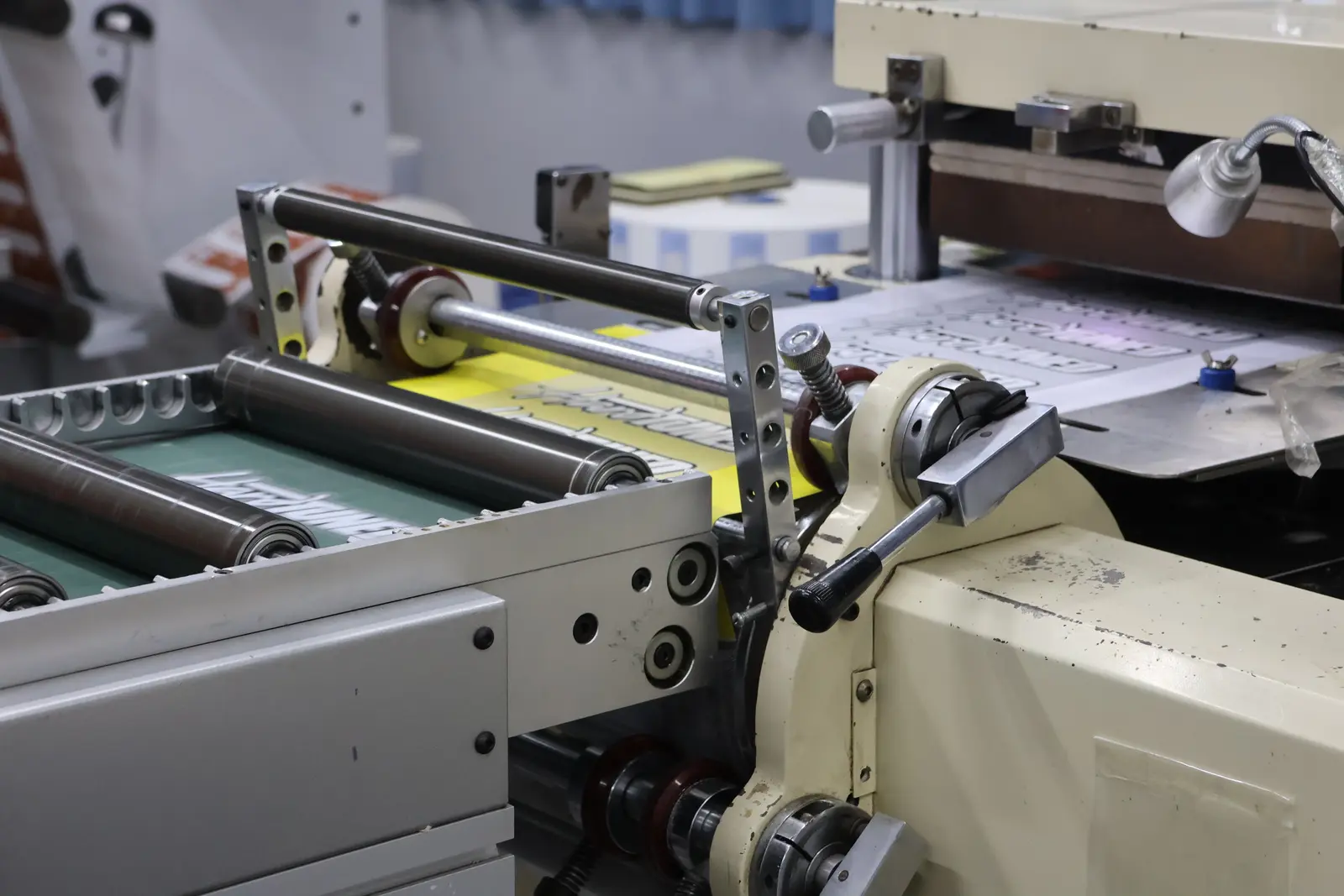
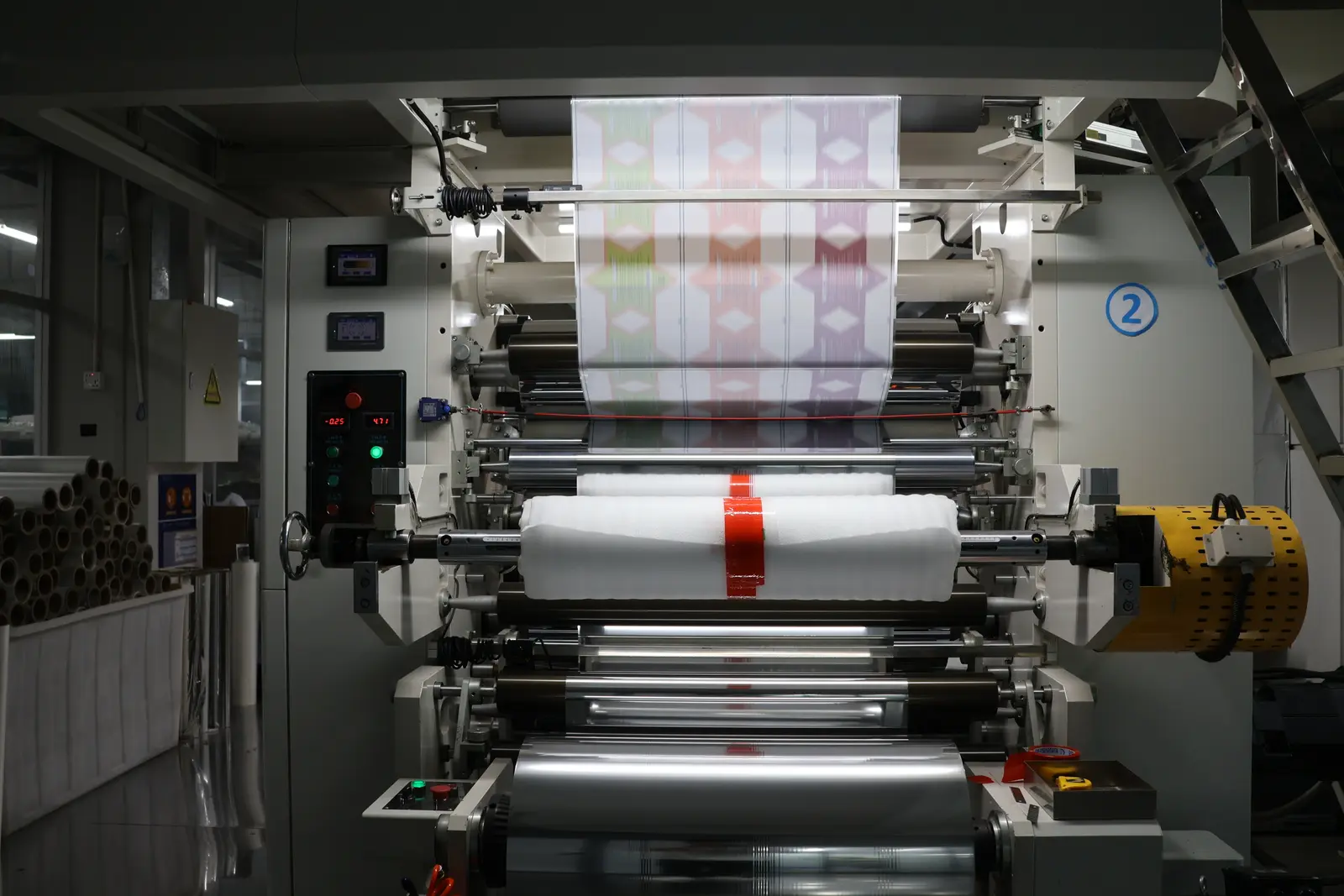
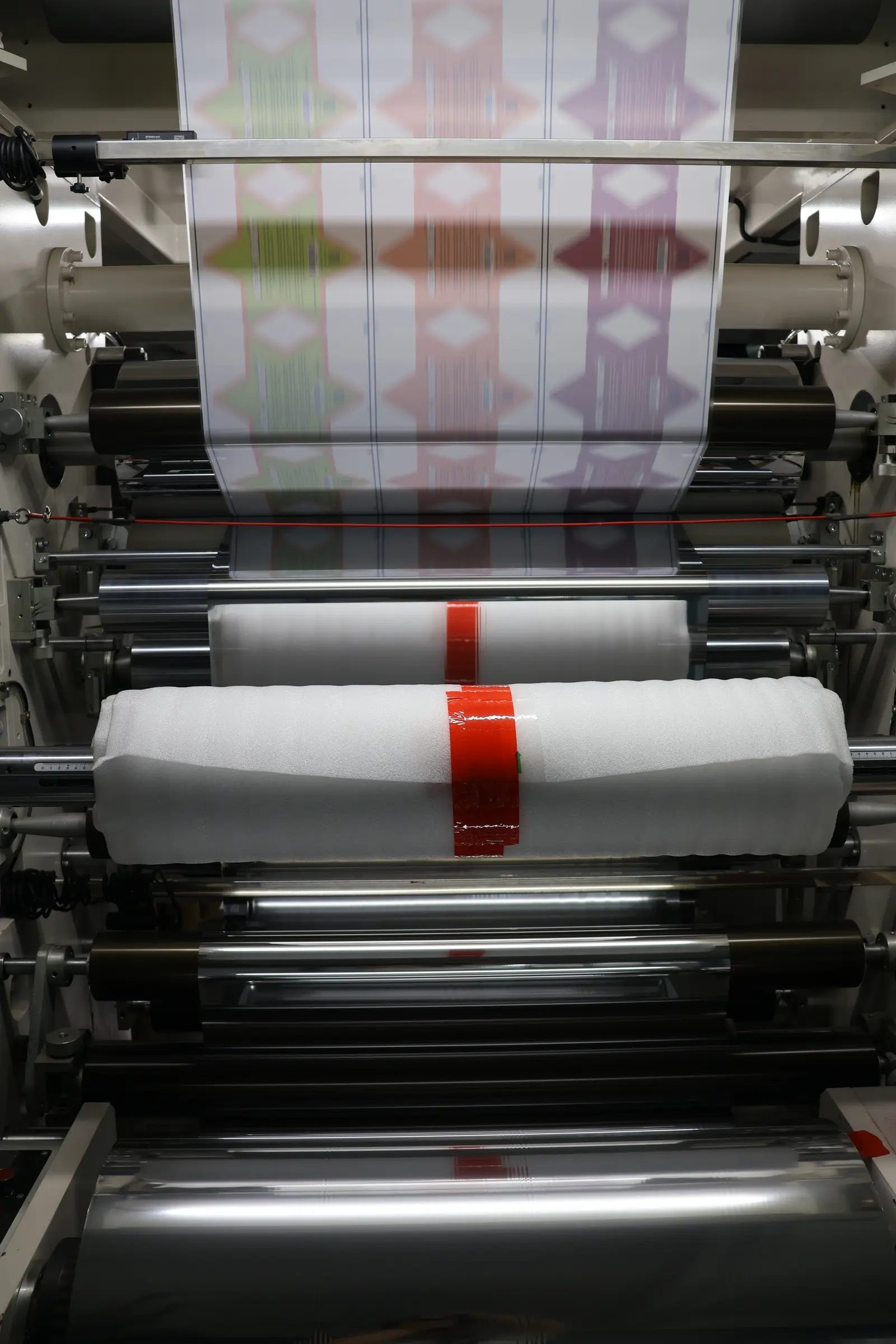
These are our own presses, films, and converting line — the equipment behind every quote.

No.01Converting
Clear window film being run on Sparal Packaging's converting line

Clear film stock for window pouches, run in-house.

Shot on our line · © Sparal Packaging

No.02Converting
Transparent clear-window film stock for custom pouches at Sparal Packaging

Clear-window film prepared for converting.

Shot on our line · © Sparal Packaging

No.03Converting
Custom-printed flexible film on Sparal Packaging's converting line

Inside production: printing, lamination, slitting, and pouch converting for custom flexible packaging.

Shot on our line · © Sparal Packaging

Order details

Choose what goes into production.

01

Normalize the quote before comparing.

If one supplier prices a plain pouch and another prices a high-barrier matte pouch with zipper, the lower quote is not a win. Make assumptions visible.

02

Ask for the reason, not just the recommendation.

Good supplier advice explains why a film, closure, format, or finish fits the product's risk and launch channel.

03

Score the workflow too.

Proof speed, file review, response quality, sample handling, and reorder support often matter as much as the first written price.

What to send

What to send for a faster quote.

These fields help us recommend the right pouch, confirm production options, and price your project with fewer back-and-forth emails.

Scorecard

MOQ, setup, proof workflow, material logic, feature support, lead time, freight, reorder control, and communication quality

Quote discipline

one shared written spec, one SKU table, and one decision date across all suppliers

Supplier risk

vague material language, missing proof stages, unclear file ownership, and incomparable minimums

Best output

two or three comparable quotes with assumptions highlighted

Quote fields

product, pouch size, material, closure, finish, quantity per SKU, artwork status, and label zones

Use case

before switching suppliers, before first custom run, or before a retail-buyer deadline

Production details

Materials, proofing, and production.

See the options that affect shelf life, print quality, cost, proof timing, and how fast the order can move.

Material choices

Barrier and structure logic

Supplier quotes without naming film assumptions

Ask for material structure, barrier reason, and feature assumptions in writing

A quote without material logic is not comparable, even if the price looks lower.

One supplier has lower MOQ but slower proofing

Compare MOQ against proof deadline and launch cost of delay

Low minimums can lose value if proofing creates missed launch windows.

Different suppliers suggest different pouch formats

Ask each to explain the format reason against product behavior

Format advice should connect to filling, shelf posture, reseal, and failure risk.

One supplier is cheapest at scale but unclear for first run

Separate first-run quote from reorder-volume quote

The right supplier may be different depending on whether the run is learning or mature replenishment.

Production checkpoints

What gets reviewed before scale

RFQ parity

Whether every supplier is responding to the same product, spec, quantity, artwork, and proof assumptions.

Material explanation

Whether the material recommendation is tied to product behavior instead of supplier convenience.

Proof workflow

The approval steps, sample needs, file requirements, and decision dates that affect launch timing.

Reorder path

Whether the quote shows how the first run changes when volume, SKU winners, or print method change later.

Quote fields

Inputs that make pricing usable

One written product brief sent to every supplier

One written product brief sent to every supplier

Pouch size or fill weight

Pouch size or fill weight, target structure, closure, finish, and feature list

Material requirement or product behavior that lets the supplier recommend material

Material requirement or product behavior that lets the supplier recommend material

SKU table with quantity per SKU and shared vs variable artwork fields

SKU table with quantity per SKU and shared vs variable artwork fields

Proof path

digital proof, physical sample need, approval owner, and change cutoff

Why it works

Built for real product launches.

01

Matches high-intent supplier comparison behavior.

02

Creates a quotable framework for AI and answer engines.

03

Pushes buyers into RFQ templates and build-quote with cleaner data.

FAQ

Questions before you order.

01What is the best way to compare packaging suppliers?

Send the same written spec to each supplier and compare the assumptions, not just the total. Include material, size, finish, features, quantity per SKU, proof workflow, and reorder scenario.

02Should I ask suppliers to match a competitor pouch?

Use competitor packs only as style references. A supplier still needs your own product behavior, dimensions, material needs, label zones, and artwork status.

03What is a red flag in packaging supplier quotes?

Red flags include unclear material structure, vague MOQ, no proof process, no file review, missing freight assumptions, and pricing that does not say what features are included.

Ready to build?

Test more designs. Pay for fewer guesses.

Send formats, quantities, artwork count, and target timeline. We will map the fastest low-risk path to proof, production, and the reorder that should come next.

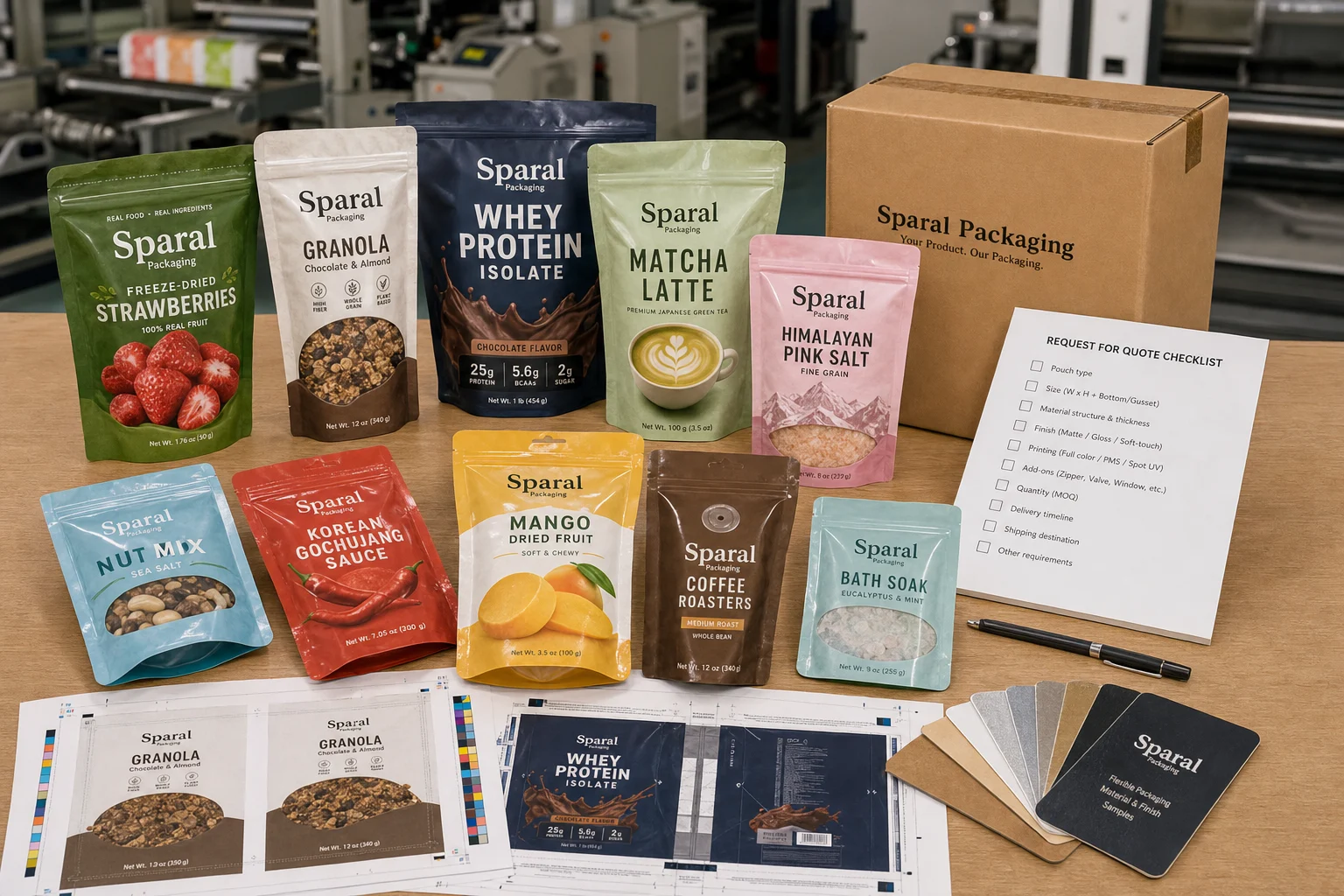
Sparal Packaging low MOQ quote kit with full-print flexible pouches, dieline proofs, RFQ checklist, and material swatches