Sparal

Equipment guide

VFFS rollstock compatibility starts with the machine, product, and seal—not the artwork.

A buyer's guide to VFFS-compatible printed rollstock: machine and forming-set inputs, web width, repeat, registration marks, unwind, seals, powder contamination, trials, and co-packer handoff.

Printed flexible packaging rollstock web prepared for form-fill-seal production

Custom packaging

Turn VFFS rollstock compatibility into a production-ready quote.

Tell us what you are packing, how many SKUs you need, and where the product will be sold. Sparal can help turn vffs rollstock compatibility into custom pouch options, proof-ready artwork, and a quote you can act on.

Best fit

VFFS rollstock compatibility

Brands and co-packers specifying printed rollstock for a vertical form-fill-seal line need one shared compatibility brief before film and artwork are released.

Send for pricing

What the supplier needs next.

Include product, pouch style, size, material, finish, quantity, SKU count, artwork status, and target date. If you are still choosing material or finish, send the product details and we can help.

Sparal quote facts

Facts to confirm before requesting pricing.

These are the concrete details a buyer and production team need: MOQ, print path, proof inputs, material review, and the next quote step.

MOQ

Any quantity accepted — a 100-pouch minimum is encouraged

Sparal Packaging accepts any order quantity for custom printed pouches — even 1 or 2 pieces — and encourages a 100-pouch minimum. Multiple colors, designs, and SKUs can be combined to reach 100.

Pricing

Pricing is quoted per project

Custom pouch pricing is quoted per project. Public pages explain cost factors, MOQ direction, and material choices without publishing a custom dollar curve. Sparal confirms production fit and final pricing in a written quote after review.

Print

Digital print path with no plate fees

Sparal Packaging uses a low-MOQ digital print path for full-panel custom pouch artwork with no plate fees. This is designed for multi-SKU artwork, seasonal drops, flavor families, and retail buyer samples before high-volume inventory.

Proof

3-5 business day digital proof target for clean files

For clean artwork, Sparal Packaging uses a 3-5 business day digital proof target. Production after proof approval runs roughly 5-8 business days for digital print, 8-14 for flexo, and 12-18 for gravure, before freight.

RFQ

Quote requests need product, quantity, artwork, and route details

For vffs rollstock compatibility, a useful Sparal Packaging RFQ includes product, fill weight or volume, pouch format, SKU count, quantity per SKU, material or barrier goal, finish, features, artwork status, target date, and ship-to country or ZIP.

Line identity

Compatibility belongs to a named machine setup

A VFFS rollstock review starts with the machine, forming set, jaw and seal configuration, product behavior, speed target, and the person at the line who can approve material requirements.

Web specification

Web width, repeat, unwind, registration, and roll limits travel together

The quote should carry finished pack dimensions, web width, print repeat, unwind and print orientation, eye-mark rules, core and roll limits, splice rules, coder zone, and the co-packer's approved material guidance.

Trial approval

Prove a new structure before exposing a full printed run

When the structure is new to the line, confirm the unprinted trial path first, then use printed trial rollstock to approve registration, unwind, repeat, coding, filled seals, and cut position before commercial release.

VFFS line compatibility proof kit

VFFS rollstock compatibility visual quote map.

Make the machine, forming set, web geometry, registration, product behavior, seal path, and trial owner visible before printed rollstock is released. Each card turns a visible package detail into the material assumption, quote check, and next step Sparal reviews before proof.

VFFS rollstock compatibility pouch family with production and quote zones by Sparal Packaging

01

Registration mark

The sensor must see the correct mark on the correct side at production speed.

02

Print repeat and seals

Critical copy and graphics must stay outside longitudinal and transverse seal areas across tolerance.

03

Lot and date code

The coder needs a compatible surface and enough stable, contrasting space after the web is formed.

04

Barcode, tear, and pack orientation

The scanner, tear path, and consumer-facing panel must still work after the web becomes a bag.

Material decision visual

Film stack and machine variables

  1. L1Print surface and treatment
  2. L2Barrier chosen for the product
  3. L3Sealant matched to the line review
  4. L4Winding, friction, and registration controls

Fine protein, collagen, electrolyte, or nutraceutical powder

Powder in the seal area can create channels even when the film and artwork meet their drawings.

Oily granules, snacks, or products with fines

The material must travel through the machine and seal around the real product—not a clean empty-pack test alone.

Quote readiness module

Send this. Avoid this.

Send

  • Machine manufacturer - Machine manufacturer, model, forming set or tube size, jaw configuration, and a technical contact at the filling site
  • Finished pack width and length - Finished pack width and length, target dose, expected headspace, seal pattern, fin or lap preference, and any tear or perforation feature
  • Required web width - Required web width, print repeat, unwind direction, print side, core, maximum roll diameter or weight, and splice limits
  • Registration sensor side plus eye-mark size - Registration sensor side plus eye-mark size, position, contrast, and artwork-free clearance
  • Product form - Product form, density, flow, dust, oils, particulates, fill temperature, and any history of seal contamination

Avoid

  • Need VFFS-compatible film for protein powder.
  • Use the same rollstock as last time.

Artwork data that is really machine data

Review the visible production zones.

Registration mark

The sensor must see the correct mark on the correct side at production speed.

Print repeat and seals

Critical copy and graphics must stay outside longitudinal and transverse seal areas across tolerance.

Lot and date code

The coder needs a compatible surface and enough stable, contrasting space after the web is formed.

Barcode, tear, and pack orientation

The scanner, tear path, and consumer-facing panel must still work after the web becomes a bag.

SKU family proof kit

Show the run as a family.

Build quote

SKU 01

Unprinted trial

Proves web handling, forming, product drop, and sealing when the structure is new.

SKU 02

Printed trial

Proves repeat, registration mark, unwind, coder zone, and cut position.

SKU 03

Variant web

Keeps the approved geometry while controlling artwork and SKU changes.

SKU 04

Reorder record

References the accepted roll specification, settings window, and intentional changes.

Continue with Premade pouches vs rollstock

The co-packer handoff

Put the line owner and the film supplier on the same one-page brief.

Most failures begin at the handoff. The brand sends artwork, the co-packer assumes a familiar film, and the converter receives no forming or registration data. Sparal supplies printed flexible packaging—not filling machinery or co-packing—and uses the compatibility brief below to coordinate the rollstock with the team that will run it.

Quote checklist

Fields to send before pricing

  • Machine manufacturer, model, forming set or tube size, jaw configuration, and a technical contact at the filling site
  • Finished pack width and length, target dose, expected headspace, seal pattern, fin or lap preference, and any tear or perforation feature
  • Required web width, print repeat, unwind direction, print side, core, maximum roll diameter or weight, and splice limits
  • Registration sensor side plus eye-mark size, position, contrast, and artwork-free clearance
  • Product form, density, flow, dust, oils, particulates, fill temperature, and any history of seal contamination
  • Target operating window: line-speed goal and the machine or co-packer's approved material, coefficient-of-friction, and seal guidance
  • Coder type, code-zone dimensions, inspection or checkweigh requirements, trial quantity, sign-off owner, and in-hands date

Material decision table

How Sparal reads the quote signal

Buyer inputQuote directionSparal review
Fine protein, collagen, electrolyte, or nutraceutical powderCoordinate product flow, dust control, seal width, jaw action, and the approved barrier structurePowder in the seal area can create channels even when the film and artwork meet their drawings.
Oily granules, snacks, or products with finesReview product drop, contamination at transverse seals, puncture risk, and the line's friction rangeThe material must travel through the machine and seal around the real product—not a clean empty-pack test alone.
New structure on an existing lineStart with an unprinted trial and record a usable temperature, dwell, pressure, and speed windowA successful trial converts assumptions into a line-specific material approval before printed inventory is exposed.
New artwork on an approved structureReconfirm repeat, eye mark, unwind, code zone, barcode orientation, and variant controlMaterial approval does not protect a job from wrong registration data or a mirrored unwind direction.

Artwork data that is really machine data

Label zones to protect

Registration mark

The sensor must see the correct mark on the correct side at production speed.

Attach the machine or co-packer rule for mark dimensions, color, contrast, position, and quiet area.

Print repeat and seals

Critical copy and graphics must stay outside longitudinal and transverse seal areas across tolerance.

Send finished length, repeat, seal widths, and any no-print or distortion zones.

Lot and date code

The coder needs a compatible surface and enough stable, contrasting space after the web is formed.

Name the coder and send the required code field, orientation, ink, and clearance.

Barcode, tear, and pack orientation

The scanner, tear path, and consumer-facing panel must still work after the web becomes a bag.

Mark the fin or lap side, top and bottom, tear direction, and final scan orientation on the dieline.

What Sparal reviews before quote

Decision checks before proof

Line ownership

Who can approve machine inputs, trial results, material range, and the commercial release.

Web-to-pack math

Web width, forming geometry, repeat, seals, unwind, print orientation, and registration.

Product-to-seal risk

Flow, dust, oils, particulates, temperature, headspace, and contamination at the final seal.

Evidence before inventory

Trial sequence, filled-pack acceptance, code and scan checks, settings record, and signed approval.

Bad brief vs good brief examples

What changes the quote quality

Bad briefGood briefWhy it works
Need VFFS-compatible film for protein powder.Quote printed rollstock for 30 g protein-powder sachets on the named VFFS model and forming set. The co-packer sheet includes web width, repeat, eye mark, unwind, fin seal, core and OD, approved-film guidance, coder zone, and four flavor quantities.The converter can quote a defined web and resolve conflicts with the line owner before print.
Use the same rollstock as last time.The structure and machine remain approved; this run adds two SKUs. Reconfirm the attached repeat, sensor-side eye mark, unwind, code box, fin-seal side, and variant table against the retained trial record before proof release.A reorder still controls the artwork and roll variables most likely to create an avoidable line stop.

Made in-house

Production record · first-party

The line that prints your pouch.

These are our own presses, films, and converting line — the equipment behind every quote.

No.01Digital press
HP Indigo 6900 digital press at Sparal Packaging's production facility

Sparal prints on an HP Indigo 6900 digital press — no printing plates, so every SKU and short run prints without per-design plate fees.

No plates · no per-design plate fees

Shot on our line · © Sparal Packaging

No.02Converting
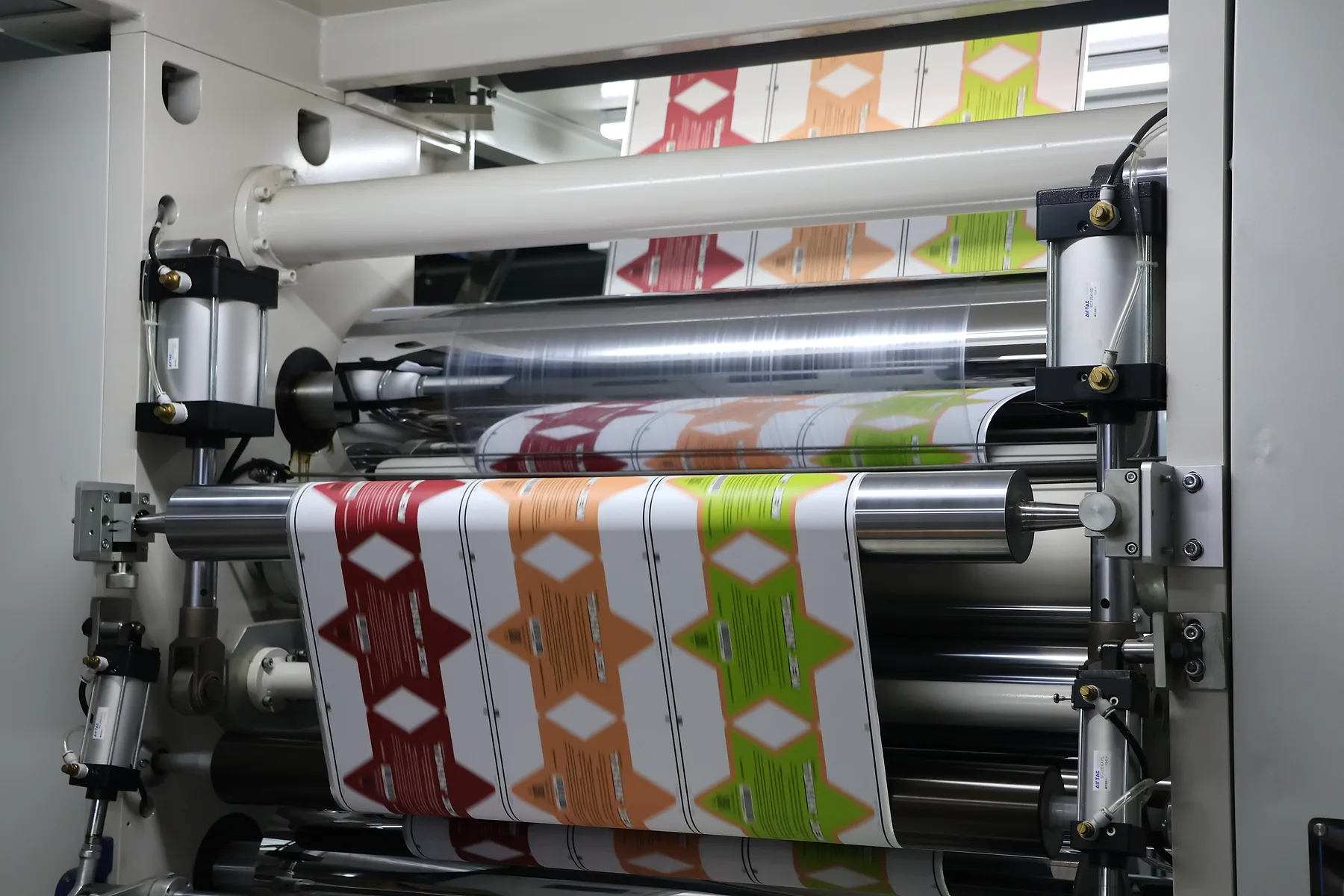
Custom-printed flexible film on Sparal Packaging's converting line

Inside production: printing, lamination, slitting, and pouch converting for custom flexible packaging.

Shot on our line · © Sparal Packaging

No.03Converting
Custom-printed flexible film on Sparal Packaging's converting line

Inside production: printing, lamination, slitting, and pouch converting for custom flexible packaging.

Shot on our line · © Sparal Packaging

Order details

Choose what goes into production.

01

The machine specification outranks a generic compatibility claim

Machine families can run different forming sets, jaws, sensors, coders, and material windows. Use the exact configuration that will produce this pack; a statement that another VFFS line ran a similar film is useful context, not approval.

02

Trial the least expensive uncertainty first

When the structure is new to the line, prove web handling, forming, sealing, product drop, and cut quality with the agreed trial sequence before committing a full printed run. When the structure is already approved, focus the printed trial on registration, unwind, repeat, codes, and SKU accuracy.

03

Keep the approval record with the reorder

Store the accepted material construction, roll specification, artwork orientation, trial settings, finished-pack checks, and approver. The next purchase order should reference that record and call out every intentional change instead of relying on ‘same as last time.’

What to send

What to send for a faster quote.

These fields help us recommend the right pouch, confirm production options, and price your project with fewer back-and-forth emails.

Machine identity

manufacturer, model, forming set, jaw type, supported material guidance, and the co-packer or line-owner contact

Web geometry

web width, finished pack width and length, print repeat, fin or lap seal, seal widths, and allowable tolerances

Roll specification

unwind direction, print orientation, core, maximum roll diameter or weight, splice rules, and winding tension requirements

Registration and coding

eye-mark size, color, contrast, position, sensor side, code area, coder type, and variable-data clearance

Product behavior

dose, density, flow, dust, oils, particulates, temperature, headspace, and contamination risk at the seal

Approval path

document review, unprinted film trial when needed, printed trial roll, filled-pack inspection, signed compatibility, and retained settings

Why it works

Built for real product launches.

01

One compatibility brief shared by brand, co-packer, machine owner, and film supplier.

02

Trial sequence separates material risk from printed-artwork risk.

03

The commercial RFQ ends in printed rollstock and pouch production—not machinery resale.

FAQ

Questions before you order.

01What does VFFS-compatible rollstock mean?

It means the rollstock has been specified and approved for a particular machine configuration, product, finished pack, seal geometry, registration system, coder, and operating window. It is not a universal film property.

02What should I ask my co-packer before ordering printed rollstock?

Ask for the machine and forming-set identity, supported web and pack dimensions, seal configuration, approved material guidance, friction or treatment needs if specified, unwind, core and roll limits, eye-mark rules, coder zone, speed target, trial process, and the person who signs compatibility.

03Why do powders cause VFFS seal failures?

Fine product can migrate into the seal area during dosing and create leak paths. Product flow, drop timing, dust control, seal geometry, jaw action, and line speed need to be reviewed together rather than treated as a film-only problem.

04Does Sparal sell VFFS machines or provide co-packing?

No. Sparal supplies custom printed pouches and rollstock. We coordinate packaging specifications with your filling line or co-packer so the material, artwork, and machine requirements agree before production.

05Should I choose premade pouches or rollstock?

Follow the filling operation. Rollstock fits form-fill-seal equipment and sufficient repeat volume; premade pouches can reduce line and setup complexity for smaller, multi-SKU, or manually filled programs. Confirm what the filler can receive before ordering either format.

Co-packer handoff review

Human reviewed

Send the line notes before you buy printed inventory.

Share whatever the machine owner or co-packer has given you. Sparal will review the web, repeat, registration, seal, product, and trial inputs that are still missing before printed rollstock is released.

Printed rollstock, matching sachets, registration marks, measuring tools, and a packaging specification drawing on a compatibility review table
Compatibility planning visualRollstock → finished pack
01

Machine and web geometry

02

Product-to-seal risk

03

Trial and sign-off owner

Short project brief

4 required fields

Start with what you know.

This goes to a packaging specialist, not an instant price calculator. We will use it to identify the missing inputs before a production quote.

Required: product, project notes, name, and work email.

Build the full RFQ instead